
Washoe Court Records After Arrest
After an arrest in Washoe County, the jail record and the court record develop on related but separate tracks. The arresting agency books the person at the Washoe County Detention Facility if county custody is required. The WCSO roster may show custody, a booking number, a housing unit, and bail after judicial action. The formal court record begins when the prosecutor files a complaint, information, indictment, or other charging document in the court that has jurisdiction over the case.
The Washoe County District Attorney's Criminal Division reviews misdemeanor, gross misdemeanor, felony, juvenile, and certain specialty matters from city, county, state, and federal law enforcement agencies. The DA's office says cases are reviewed for prosecution in justice courts, district courts, and the grand jury. Court records after a jail arrest are therefore best understood as the filed charge record, not just the arrest event. For custody and booking details, use Washoe County jail inmate records. For booking-photo limits, use the Washoe County jail roster mugshots topic.
Search Washoe Court Records
The main district court search route is the Second Judicial District Court public case search. It is useful for felony and district-court cases after filing, and it supports name, case, company, department, and cross-reference searches. Official court pages also provide paths for Reno Justice Court and Sparks Justice Court. Lower-court routing often depends on the court of jurisdiction shown by the jail roster, sheriff app, bail page, citation page, or release paperwork.
| Field Label | Type | Required | Options / Format Notes |
|---|---|---|---|
| Case Number | Text + operator | One of required group | Operators include equals, starts with, contains, soundex, blank, not blank, and null variants. |
| Case Name | Text + operator | One of required group | The portal tip recommends starting with Case Name and partial names. |
| Filed | Date / range | Optional | Date picker includes today, tomorrow, yesterday, empty, next or last periods, single day, and user select. |
| Party Last Name | Text + operator | One of required group | Uses the same operator list as case fields. |
| Party First Name | Text + operator | Optional narrowing | Useful for common last names. |
| Company Name | Text + operator | One of required group | Business-party search field. |
| Department | Dropdown / multiselect | Optional | Includes departments 1-16, Delinquency, Dependency, Domestic Violence, Probate, UIFSA, and Arbitration. |
| Cross Reference Number | Text + operator | One of required group | Uses the same operator list as case fields. |
| CAPTCHA | Math question | Yes | Required anti-automation check. |
The Second Judicial District Court case-search screen shows the fields used to find court records after a Washoe County arrest.
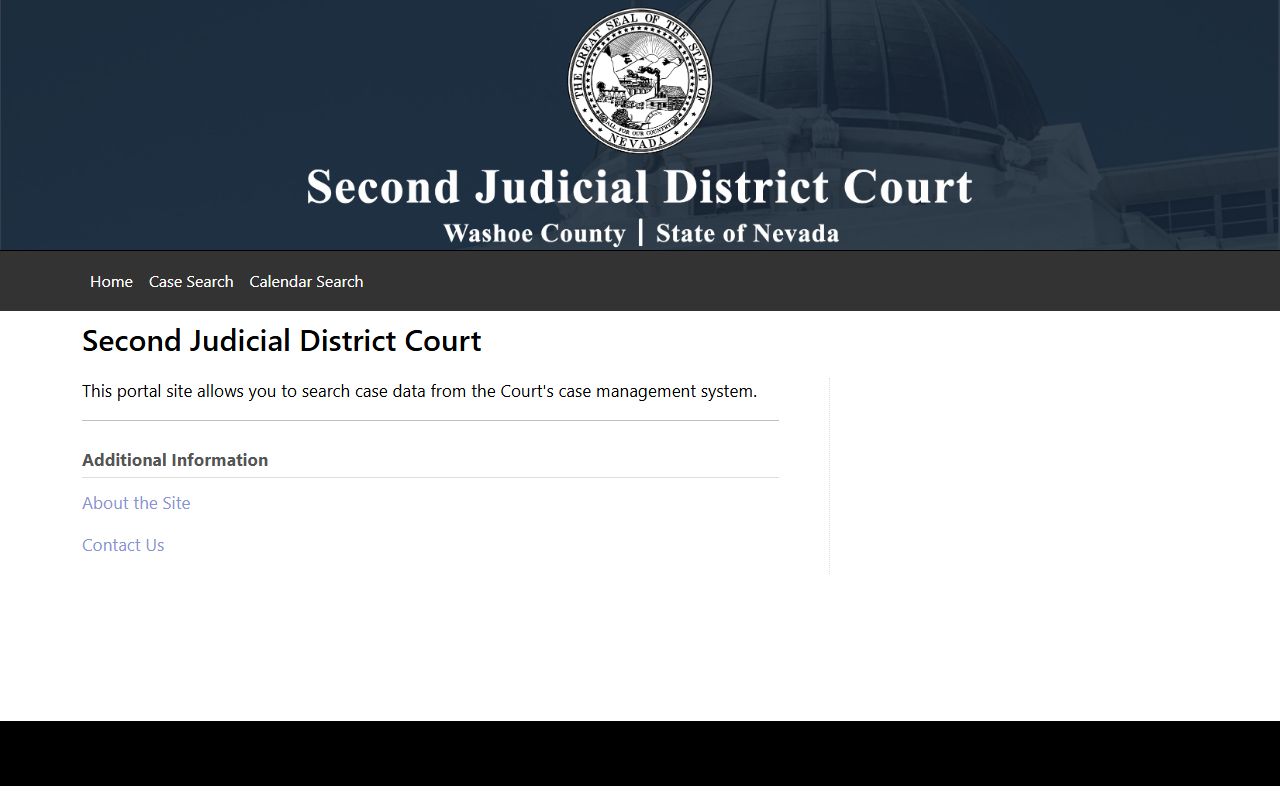
The field set is broader than the jail roster because court records can be searched by case identity, party identity, filing date, department, and cross-reference number.
Find Court Records After Arrest
A practical Washoe County court-record search starts with the custody source only long enough to get identifying facts. The jail roster may supply a name, booking number, bail note, or court jurisdiction. The court portal then supplies the filed case. If the person was recently booked, the court record may not appear until the prosecutor files or the clerk enters the case.
- Confirm the person was booked and note the spelling, booking number, and court jurisdiction if available.
- Search the Second Judicial District Court portal by case name, party last name, first name, or case number.
- For lower-court matters, use Reno Justice Court, Sparks Justice Court, municipal court, or Incline Village Justice Court based on jurisdiction.
- Open the case and read the charge list, filing date, next hearing, warrant status, and disposition fields.
- Request copies from the clerk or Resource Center when a docket entry is not enough.
The Second Judicial District Court copy process says people can request copies and appear in person at One South Sierra Street in Reno with the case number and payment method. Copy procedure varies by type, so a docket lookup and a certified-copy request are separate tasks.
Washoe Court Charging Documents
The charging document is the bridge between an arrest and a formal court case. It states what offense the government is pursuing and gives the court a case to manage. In Washoe County, the District Attorney's Criminal Division receives investigations, reviews them for possible prosecution, and uses prosecution teams for felony and gross misdemeanor matters. Some cases remain in justice or municipal court, while serious matters may move to district court or grand jury review.
| Document | Who Usually Files or Uses It | Common Role After Arrest |
|---|---|---|
| Complaint | Prosecutor or charging authority | Often starts a criminal case in justice or municipal court, including misdemeanor and early felony processing. |
| Information | Prosecutor | Formal felony or gross misdemeanor charging document after review or preliminary proceedings. |
| Indictment | Grand jury process | Charge path used when a grand jury returns charges, often in serious or complex matters. |
These documents can differ from the booking charge. A jail record may reflect the arresting agency's initial reason for custody, while the DA-filed court record reflects the charge that the prosecution has chosen to pursue at that stage.
Washoe Court Charge Status
Charges can change after a jail arrest. A prosecutor may file fewer charges than the arresting agency listed. A court may dismiss a count. A plea can reduce an offense. An amended charging document can replace the first version. For that reason, a Washoe County court record should be checked for both the charge label and its status. The current status says more than the fact that a person was booked.
| Status | What It Means | Why It Matters |
|---|---|---|
| Pending | The charge is active and has not reached final disposition. | Future hearings, bond conditions, and warrants may still change. |
| Amended | The charge text or count was changed by a later filing or order. | The original booking charge may no longer be the best summary. |
| Reduced | The charge level or offense was lowered, often by plea or amendment. | A felony booking path can end with a lower-level disposition. |
| Dismissed | The court or prosecutor ended that count without a conviction on it. | Dismissal is not the same as a sealed public record. |
| Convicted | A plea or verdict resulted in a finding of guilt. | This is the status most different from a mere accusation. |
Washoe Court Bond After Arrest
Bond and release information can appear in both jail and court records after a Washoe County arrest. WCSO release procedures say all inmates are interviewed for own-recognizance release by Pretrial Services within 24 hours. If OR is denied, bail is set or the person remains held without bail until court review. The WCSO roster disclaimer also says bail is no longer automatic on new charges and updates after a judge promptly sets it.
| Release or Payment Type | How It Works in Washoe Research |
|---|---|
| Own Recognizance / OR | Release without posting bail when Pretrial Services and the court allow release with conditions. |
| U.S. Currency | Accepted by courts for posting bail. |
| Certified or Cashier's Check | Must be drawn on U.S. banks. |
| Postal Money Order | Amount must be typed or stamped. |
| Bail-Agent Bond | Accepted except for cash-only bails and fines. |
| Online GovPayNow Card Payment | WCSO says card payment can be made for cash bail only. |
The WCSO release procedures page lists bail payment types, online payment requirements, release timing, and the Nevada bail-deposit notice.
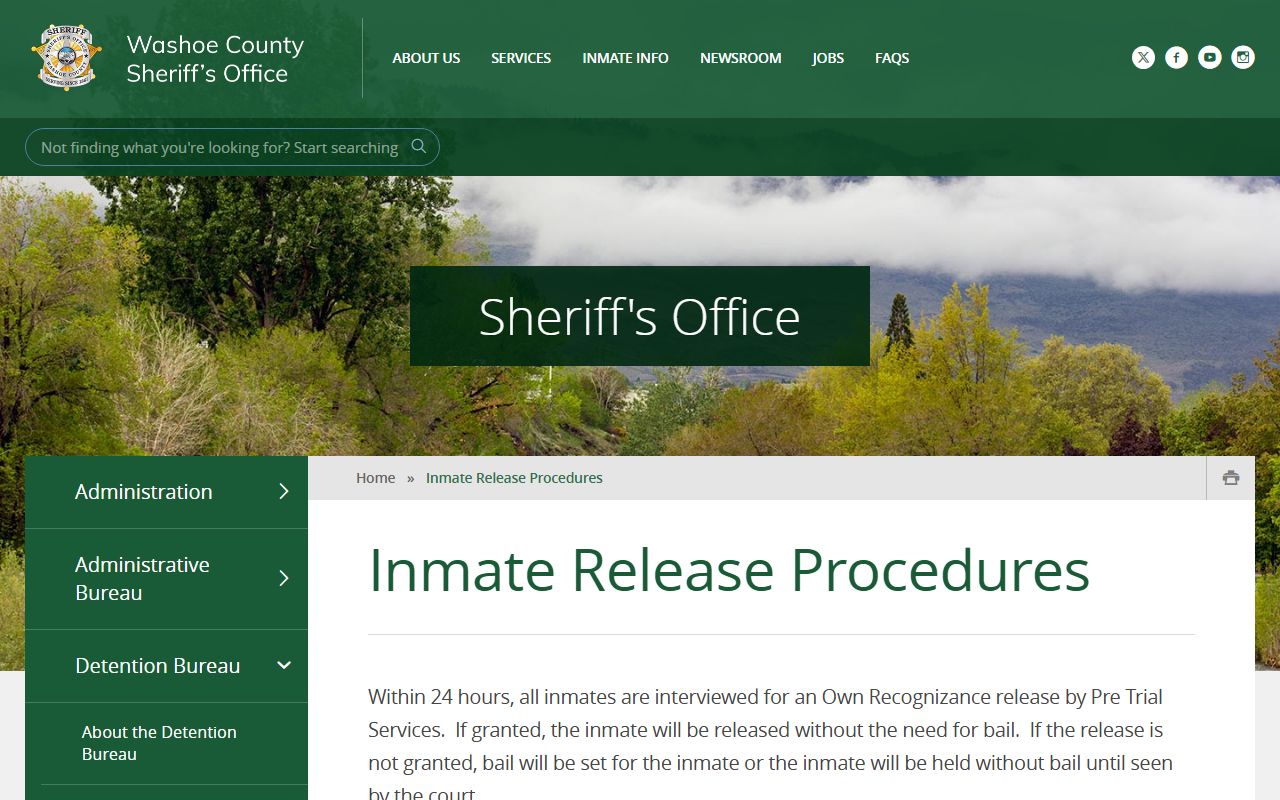
Bond data should still be verified with the court or jail because another hold, detainer, no-bail order, immigration hold, or probation matter can block release after payment.
Washoe Court Warrant Routing
No official Washoe County Sheriff's Office public active-warrant search was located in official-source materials. Warrant questions should therefore be routed through the relevant court and official records channels, not through unofficial warrant sites. Reno Justice Court publishes warrant-resolution instructions for bench warrants and warns that a person with an active warrant is subject to arrest at any time. The court can set an Order to Show Cause, but the warrant remains active until the person appears before a judge.
If a person is arrested on a warrant and booked into the Washoe County Detention Facility, the WCSO roster may show the current custody record after booking. The basis for the warrant, the court that issued it, the bond or no-bond status, and the next hearing belong in the court record. Reno Justice Court also publishes a traffic-warrant page and gives the Citation Division phone for existing traffic warrants.
| Warrant Question | Official Route |
|---|---|
| Was the person booked after arrest? | Use the WCSO roster and booking information line. |
| What court issued the warrant? | Search the relevant court by name or case number. |
| How is a Reno Justice bench warrant resolved? | Use Reno Justice Court's warrant-resolution instructions and court contact process. |
| Need incident or detention records? | Use WCSO Records or the GovQA request portal. |
Court Charges vs Convictions
A charge is an accusation. A conviction is the result of a plea or verdict. Court records after a jail arrest may show charges for months before final disposition, and some charges never become convictions. This distinction matters when reading Washoe County court records because a booking record can make a case look final when it is still at the accusation stage.
| Point | Charge | Conviction |
|---|---|---|
| Stage | Filed accusation after arrest or investigation review. | Final guilt finding through plea or verdict. |
| Proof Level | Based on charging standards and probable cause concepts. | Requires proof beyond a reasonable doubt or a valid plea. |
| Can Change? | Can be amended, reduced, dismissed, or replaced. | Can still be appealed or later sealed if eligible, but it is a final case outcome. |
| Where to Verify | Court docket and charging document. | Judgment, disposition, minute order, or certified court copy. |
Sealed vs Expunged Court Records
Nevada materials for Washoe County point to sealing as the relevant public-access concept. Nevada criminal-history rules and public-records law do not make every arrest, dismissal, juvenile item, or sealed case open for casual lookup. If a case is sealed, public access is limited even though law enforcement or certain agencies may retain controlled access. Expungement, in the common plain-English sense of destroying or treating a record as if it never existed, should not be assumed when Nevada materials are discussing sealing.
| Point | Sealed | Expunged |
|---|---|---|
| Public Visibility | Hidden or restricted from ordinary public access after a court order. | Often means destroyed or treated as never existing in states that use expungement. |
| Nevada Use | Sealing is the Nevada access-limiting process identified in the official-source materials. | Do not assume Nevada uses this term for every cleared record. |
| Agency Access | Some official access may remain under criminal-history laws. | Depends on the law that created the remedy. |
| Best Verification | Court order and clerk confirmation. | Court order or statute specific to the record type. |
NRS Chapter 239 gives the public-records route for nonconfidential records, while NRS Chapter 179A governs criminal-history records and dissemination limits. Those statutes explain why jail, court, and criminal-history records can have different access rules.
Washoe Court Record Limits
Nevada's public-records law generally supports inspection and copying of public books and records unless a record is confidential by law. That does not mean every court or criminal-history item appears online. Juvenile matters, sealed records, protected victim information, confidential criminal-history data, and some active-investigation materials can be restricted. WCSO's current mugshot notice also shows that privacy and due-process balancing can affect what appears in a public-facing custody search.
For court records after a jail arrest, the best source is the court that holds the case. For agency reports and detention records, use WCSO Records or the county public-records channels. For prosecutor discovery intake, the DA publishes a records email for law-enforcement and defense attorney discovery, but the DA page warns it is not for criminal reports or records outside discovery. That split keeps custody records, prosecution records, and court files in their proper lanes.
Note: A public search result is not a consumer report and should not be used for FCRA-covered screening decisions.
Washoe DA Court Review
The Washoe County District Attorney's Office is located at the Mills B. Lane Justice Center, 1 South Sierra Street, South Tower, 4th Floor, Reno, NV 89501. General inquiries go to 775-328-3200. The DA page identifies Christopher J. Hicks as District Attorney and describes Criminal, Civil, Family Support, and Administration divisions. The Criminal Division handles felony, gross misdemeanor, juvenile crime, and certain misdemeanor matters.
The DA's Criminal Division page is especially relevant to court records after an arrest. It says the office receives investigations from city, county, state, and federal law enforcement, then reviews cases for prosecution in justice courts, district courts, and the grand jury. It also names a Bail and Intake Team created in 2022 to address legislative and judicial changes requiring daily bail hearings for recently arrested people. That team helps explain why bail and first-appearance information may update after booking rather than appearing as a fixed number at arrest.